
Employment law for public-sector employers
Is a recruitment decision being challenged, has the staff council raised objections, or are long periods of absence disrupting day-to-day operations? You need to remain able to act whilst complying with legal requirements. As specialist solicitors in employment law, we support you in carefully preparing decisions and resolving conflicts. Find out which steps can minimise risks – before commitments, project launches or dismissals become a fait accompli.
Ensuring the legal validity of
staff appointments and
salary grading
An urgent vacancy does not justify cutting corners in the selection process. When filling public offices, suitability, competence and professional performance are what count. We review the job profile, the vacancy notice and the selection report, as well as the obligations towards applicants with severe disabilities. This enables you to provide a clear and transparent justification for your decision and to identify at an early stage any risks associated with competitive selection procedures or claims for compensation.
Project funding or temporary cover often raise the question of fixed-term contracts. We check the legal grounds for a fixed-term contract, previous employment history and the required formalities before work commences. You should also agree on any contract amendments and extensions in advance: a mistake could result in a permanent employment relationship being established – despite limited funding or staffing plans to the contrary.
When determining pay grades, the key factors are the duties assigned and the applicable pay scale, not merely the job title or the budget allocation. We can assist you with job descriptions, collective agreement-based pay assessments and pay grade allocation. In the event of requests for reclassification to a higher pay grade, we examine potential entitlements, limitation periods and the involvement of the staff council, so that you can defend your remuneration decisions with confidence.
Establish selection criteria before reviewing the applications. Document assessments in a consistent manner and provide reasons for your selection in a timely manner. Before making a binding offer, clarify any participation obligations, the protection of applicants’ rights and, in the case of fixed-term contracts, the form of the contract prior to the start of employment.
Frequently asked questions about selection and collective bargaining law
Does the ‘best-and-brightest’ selection process also apply to employees on collective agreements?
Yes, when it comes to filling public offices, Article 33(2) of the Basic Law generally also covers employment relationships. The decisive factors are suitability, competence and professional performance. The job profile must be appropriate and the selection process must be documented in a transparent manner.
Do we always have to invite applicants with severe disabilities to interview?
Public sector employers must, as a general rule, invite applicants with severe disabilities and those treated as such to an interview. Under Section 165 of SGB IX, the invitation is not required if the applicant clearly lacks the necessary professional qualifications. A merely lower assessment is not sufficient grounds for this.
What should you do if the selection decision is challenged?
Keep a complete record of the selection process and, before making the final appointment, check which notification and waiting period requirements apply. Unsuccessful applicants may seek urgent legal redress. A hasty offer of employment may create additional risks.
Do temporary budgetary allocations justify a fixed-term contract?
Not automatically. A fixed-term contract based on budgetary considerations requires that the statutory conditions be met; funding that is only temporarily secured is not always sufficient. We assess whether there is a valid objective reason or whether the fixed term is permissible without an objective reason.
Can we agree on the pay band freely?
Where the automatic pay-scale classification system is in force, the pay band is determined by the relevant job characteristics. The staffing plan or budget does not replace this assessment. Permissible allowances and other recruitment measures must be assessed separately.
When should we seek legal advice?
Ideally, before the tender is issued, the contract is signed or more senior duties are assigned. If a complaint has already been lodged, an urgent application has been made or claims for remuneration have been raised, you should have the selection documents, contracts and specified deadlines reviewed immediately.
Working with the Staff Council to
shape working hours and digitalisation
New rota schedules, remote working or a reorganisation cannot be managed solely through the project plan. We clarify whether co-determination, participation or consultation is required, and which staff representative body is responsible. You will receive support in ensuring full disclosure and planning the procedures. This enables you to take participation rights into account at an early stage, rather than having to argue about responsibilities and deadlines shortly before implementation.
When it comes to time recording, digital HR management and AI applications, what matters most are the actual functions and data flows. We review access rights and work with you to develop rules governing access, data analysis, deletion and updates. A service agreement can set out the terms of use in a binding manner. However, it does not replace a sound legal basis under data protection law, nor does it replace the need to assess other legal requirements.
If differences of opinion are holding up implementation, we structure the negotiations and examine the available dispute resolution options. Depending on the relevant legislation and the matter at hand, we may consider a tiered procedure, an arbitration panel or court proceedings. We draw up service agreements within the limits set by law and collective agreements – with clear responsibilities, workable rules and procedures for future amendments.

Baden-Württemberg State Staff Representation Act
Basic commentary including the electoral regulations and supplementary provisions. Useful for public authorities in Baden-Württemberg in understanding participation rights and procedural requirements under the LPVG. It remains necessary to examine the specific measure.
View the book at the publisher's website ↗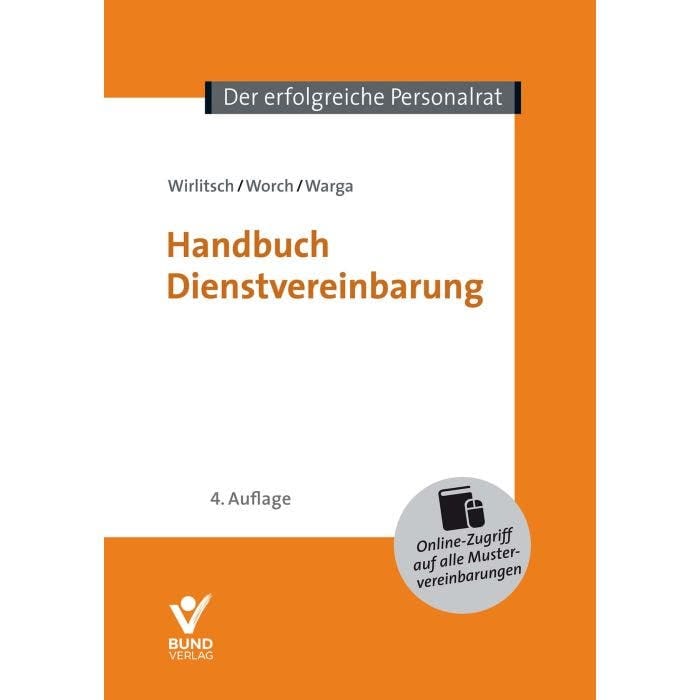
Service Agreement Handbook
Designed for staff councils, but also useful for departments as preparation for negotiations: key information and templates on working hours, remote working and technical systems.
View the book at the publisher's website ↗Make provision for staff involvement right from the project approval stage. Set out the functions, data flows, employee groups affected and the desired start date. A procured system or a tight schedule is no substitute for a properly completed consultation process.
Frequently asked questions about working with the staff council
Which Staff Representation Act applies to our department?
As a general rule, the BPersVG applies to federal government departments, whilst the relevant regional legislation applies to regional and local government departments. In the case of publicly controlled companies organised under private law, the BetrVG may apply instead. The legal form and administrative classification must be clarified first.
Can we go ahead if the staff council doesn’t reply?
Only if the applicable law provides for the relevant legal consequence and all the conditions are met. In particular, check that full information has been provided, and the start and end dates of the time limit. Mere silence does not constitute general authorisation to proceed.
Is a software pilot project already subject to the requirement to seek participation?
This may also be the case even with a limited trial. What matters is the actual use, the functions involved and the employees affected, not whether it is labelled a ‘pilot’. Check the scope of participation and data protection before any real employee data is processed.
What should be included in a service agreement regarding working hours?
Depending on requirements, these may include working hours, breaks, working time accounts, rota planning and availability. Rules must be consistent with operational requirements and employee protection. Statutory requirements, the primacy of collective agreements and permissible derogations place limits on how these arrangements are structured.
What should you do if consent is refused?
Check the grounds, time limits and the further procedure laid down by law. Depending on the case, renewed negotiations, a multi-stage procedure or a conciliation board may be considered. A provisional settlement is only permissible if the relevant legal conditions are met.
To what extent do shareholder rights apply in the event of restructuring?
Organisational decisions and their individual implications for employees must be examined separately. Even though not every fundamental decision is subject to co-determination, measures such as transfers or changes to working hours may trigger the right to participation. The provisions of the BetrVG cannot be applied across the board.
Handling absences, breaches of duty
and dismissals
Prolonged or recurring incapacity for work requires a structured approach, not a hasty termination of employment. We assess the obligation to provide workplace integration management (BEM), offer support with the invitation process and data protection, and evaluate possible workplace adjustments. If dismissal on health grounds is being considered, we clarify the prognosis, the demands of the role and less drastic measures – including alternative employment opportunities.
In cases of suspected breaches of duty, you need solid evidence and a proportionate approach. We will help you to clarify the facts of the matter promptly, secure evidence lawfully and prepare any necessary hearings. Together, we will assess whether a discussion, a written warning or another measure is appropriate. In the case of summary dismissal, particular attention must be paid to the short limitation period set out in Section 626(2) of the German Civil Code (BGB).
In cases of suspected breaches of duty, you need solid evidence and a proportionate approach. We will help you to clarify the facts of the matter promptly, secure evidence lawfully and prepare any necessary hearings. Together, we will assess whether a discussion, a written warning or another measure is appropriate. In the case of summary dismissal, particular attention must be paid to the short limitation period set out in Section 626(2) of the German Civil Code (BGB).
Establish a timeline at an early stage: what happened and when, who was informed and when, and what measures have already been considered? Keep BEM health records separate from the general personnel file. Ensure that deadlines, involvement and any necessary consents are checked before any dismissal takes place.
Frequently asked questions about BEM and redundancies
When must we offer a BEM (workplace reintegration management) process?
If employees are unable to work for more than six weeks, either continuously or on repeated occasions, within a single year, a BEM must, as a general rule, be offered in accordance with Section 167(2) of SGB IX. This applies not only in cases of severe disability. Participation requires the consent of the person concerned.
Does the absence of a BEM preclude dismissal?
Not automatically. A BEM is not a formal prerequisite for validity. However, if a required BEM is missing, the employer must generally provide a particularly detailed explanation of why no suitable less onerous measures were available. A proper search procedure is therefore important.
Is a written warning always required before dismissal?
In the case of misconduct that is within the employee’s control, a formal warning is generally required as a first step. Exceptions may apply, for example, in the case of particularly serious breaches of duty or where there is clearly no prospect of a change in behaviour. Illness, in itself, does not constitute conduct warranting a formal warning.
What is the notice period for termination for cause?
In principle, two weeks from the date on which the person authorised to give notice became aware of the relevant facts (Section 626(2) of the German Civil Code (BGB)). Investigations, hearings and any necessary consultation require precise timing. Do not wait until internal discussions have been concluded before carrying out the legal assessment.
Is the staff council’s involvement sufficient?
Not always. In addition, it may be necessary to involve, for example, the representatives for people with severe disabilities, the equal opportunities officer or the relevant authorities. In cases where special protection against dismissal applies, prior official approval may be required. Involving the staff council does not replace these checks.
How should we respond to a claim for unfair dismissal?
Forward any claims and court orders immediately for review. Secure documentation relating to the grounds for termination, the parties involved and the date of receipt. We will assess the risks relating to continued employment and remuneration and work with you to prepare a defence or a legally valid settlement.

A clear next step.
Please outline the decision you are facing and your timetable. We will clarify the scope of our advice and any potential conflicts of interest before taking on your case.
Legal notice: This information does not replace an assessment of individual cases. The decisive factors are, in particular, the employee’s status, the applicable collective bargaining and staff representation legislation, and the specific measure in question.


